Log in on desktop / phone :) thank you!
Yo! I'm Ron, a Tel Aviv-based Graphic Designer.
I combine design, product thinking, marketing, and growth strategy to create meaningful solutions.

VIZI — CASE STUDY
Turn AI Search Data
Into Action
Turn AI Search Data
Into Action
ROLE
Product Designer, Branding,
Co-Founder
PRODUCT
B2B SaaS · GEO / AI Search
TEAM
Product, Engineering,
SEO Domain Expert
OWNERSHIP
Product Strategy, User Research, End-to-end UX/UI, Prototyping
VIZI helps brands understand and improve how they appear across AI search engines like ChatGPT, Gemini, Claude and Perplexity.
THE PROBLEM
AI search analytics gives SEO teams more data, but not a clear path to action
THE PROBLEM
AI search analytics gives SEO teams more data, but not a clear path to action
VIZI helps SEO teams monitor how brands appear across AI engines like ChatGPT, Gemini, Claude, and Perplexity. But the early product, like many GEO tools, was dashboard-heavy: it surfaced scores, prompts, mentions, competitors, and sources, while still leaving users to interpret the data, decide what mattered, and manually turn insights into action.
the solution
Closing the loop between
insights and action
Our goal was to create one continuous workflow where SEO professionals can monitor their AI visibility, investigate what matters, and act on what they find, without losing the control and depth they expect.
Early Research
Start lean, learn from real users
Our initial research was intentionally lightweight. We combined a quick competitor benchmark with early conversations with SEO professionals to understand the market and identify the core problem.
Benchmark the GEO market
GEO Platforms




SEO Platforms expanding




OUR PRODUCT

GEO Platforms
GEO Platforms
SEO Platforms expanding
OUR PRODUCT
OUR PRODUCT
I studied GEO-native tools and established SEO platforms expanding into AI search to understand what they do well, where the experience falls short, and where VIZI could differentiate.
Market insights
The market is strong at tracking visibility, competitors, prompts, mentions, and citations, giving SEO professionals the depth of data they expect. But most experiences remain dashboard-heavy and require users to interpret the data themselves, with limited prioritization or guidance on what to do next.
What I took going forward
The opportunity wasn’t to give users more data, but to reduce the work required to make sense of it. VIZI needed to preserve the depth and control SEO professionals expect, while helping them identify what matters, understand why it matters, and turn insights into action.
WHERE WE STARTED
We shipped. Then we watched.
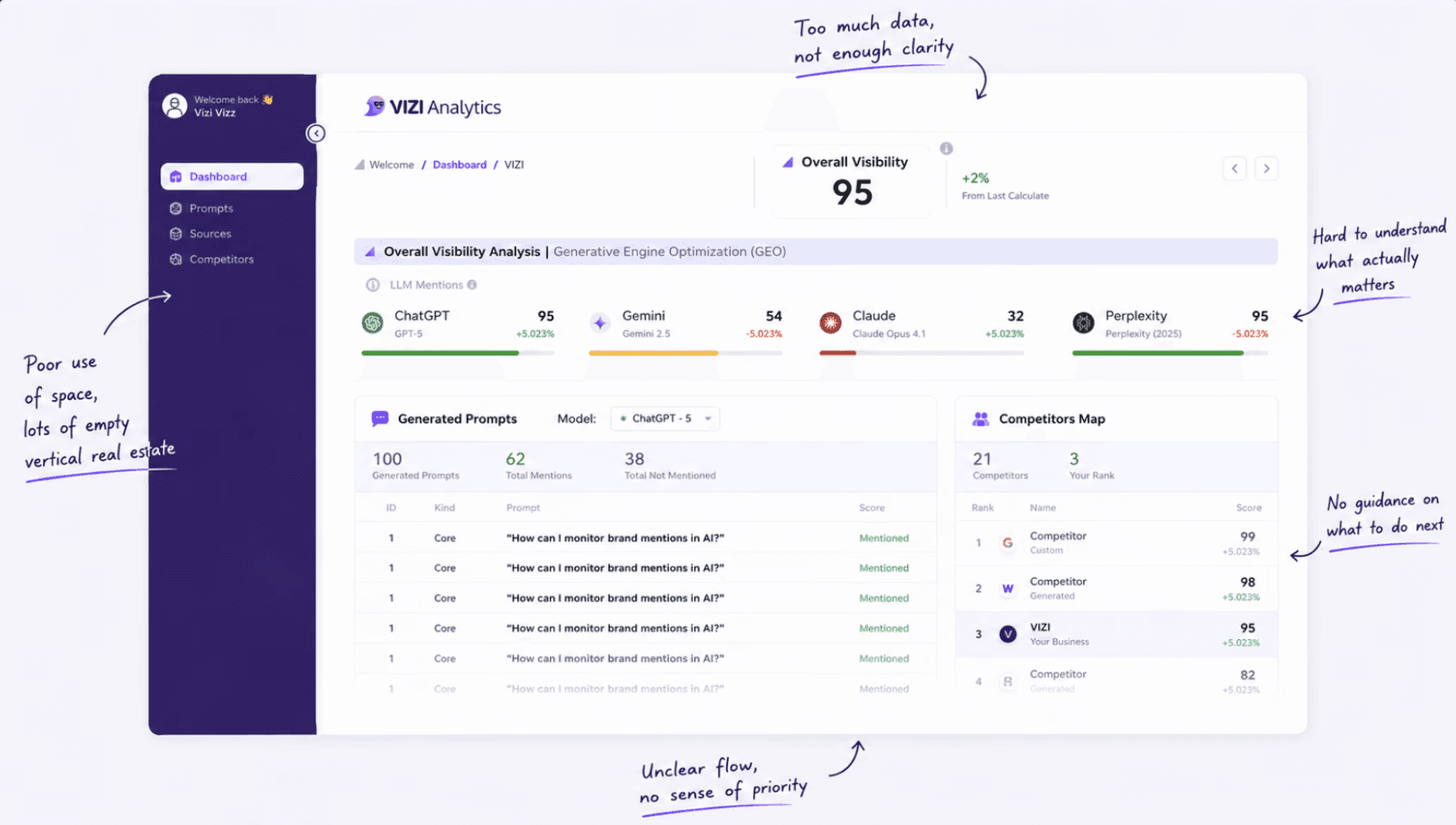
The first version of VIZI was a pre-MVP built to learn. We shipped quickly to understand how SEO professionals worked with AI visibility data and uncover their real needs.
It validated the problem, but revealed a bigger one: We were giving users information - but still leaving them to figure out what to do with it.

LEARNING FROM REAL USERS
We stopped designing around assumptions
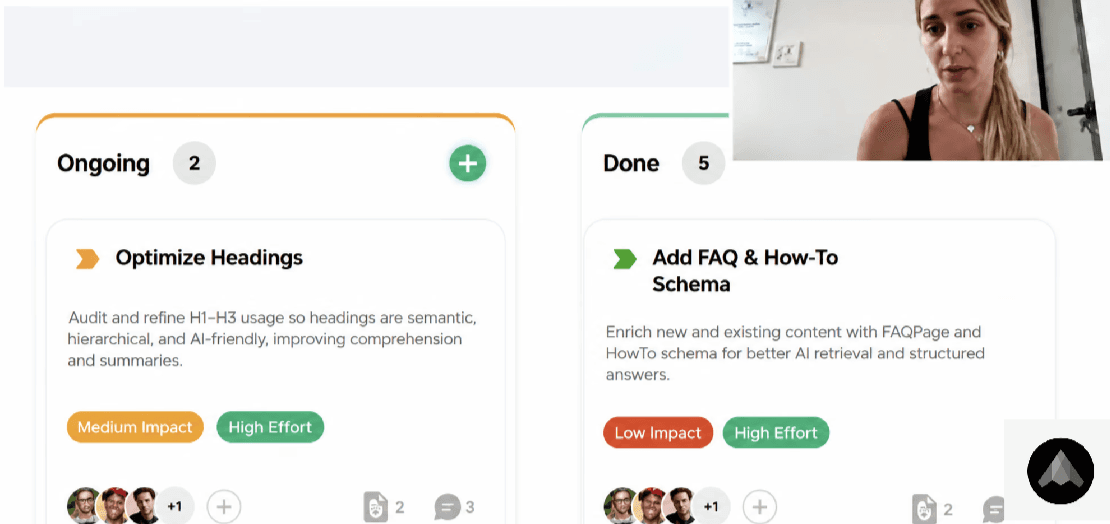
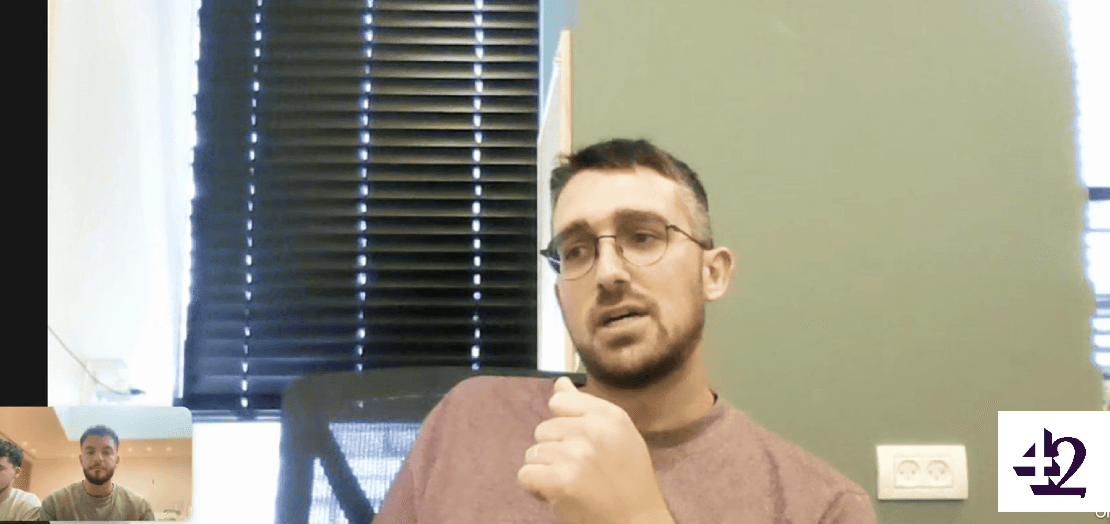
We spoke with 30+ users and prospects throughout the product lifecycle — before the platform existed, during early validation, and after people had used the product. We combined interviews, feedback calls and recordings of real product usage to understand not only what users said they wanted, but how they actually worked.
150
Research & feedback touchpoints
30
Design partners & prospects
3
Major product directions
Multiple
Usage recordings & feedback rounds


[ USER INTERVIEW / CALL SCREENSHOT ]


[ RESEARCH NOTES ]


[ USER FEEDBACK ]


[ PRODUCT USAGE RECORDING ]

User Flows
Mapping the core product flows
Working closely with our developers, I mapped the journey from onboarding and monitoring to insights, projects, and publishing. The flow helped us define how users could move from understanding what’s happening to actually doing something about it.
As the product evolved, we refined where AI should guide the user, where it should suggest an action, and where users should stay in control.
Working closely with our developers, I mapped the journey from onboarding and monitoring to insights, projects, and publishing. The flow helped us define how users could move from understanding what’s happening to actually doing something about it.


Onboarding Design
Balancing confidence with playfulness
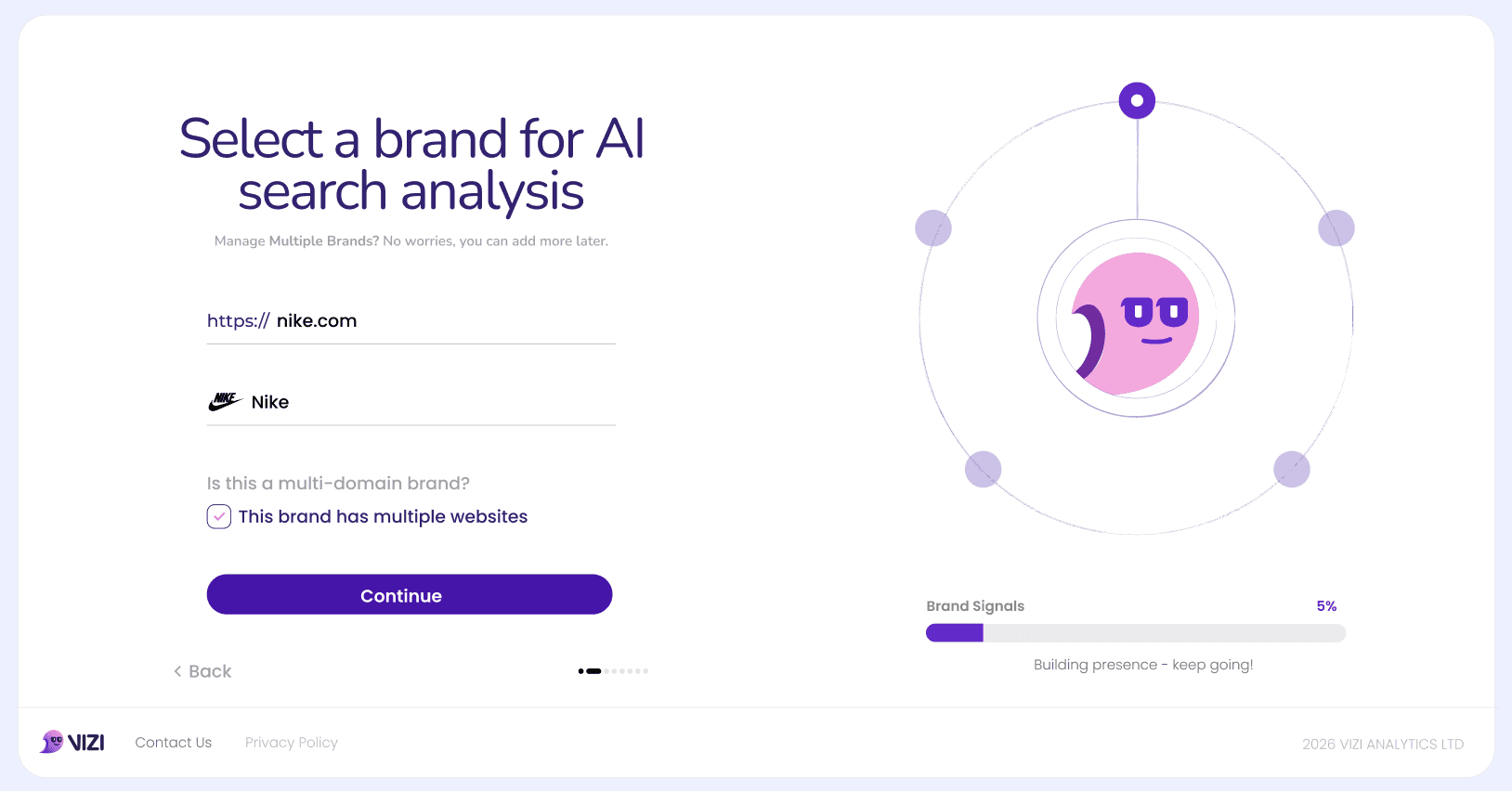
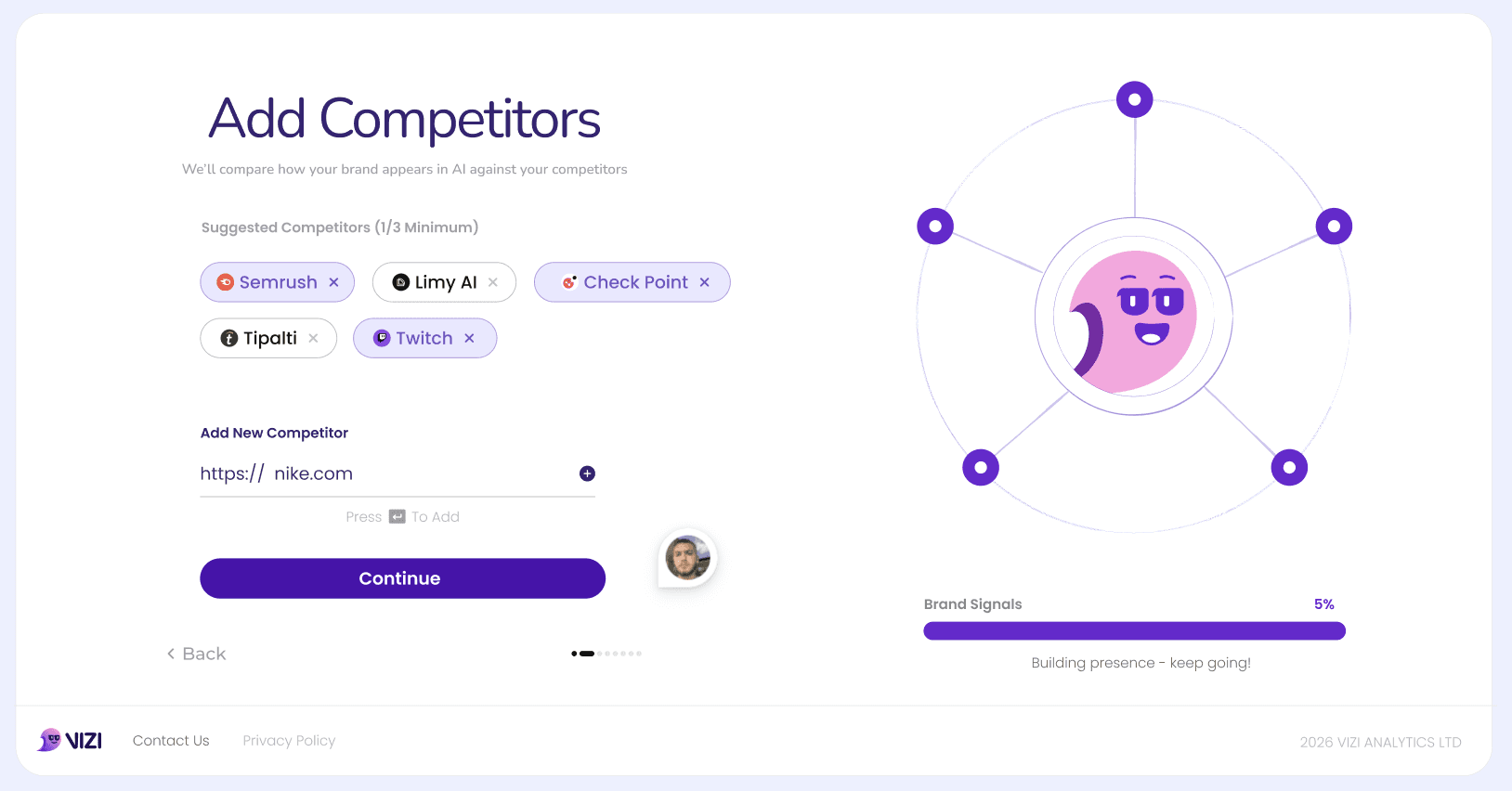
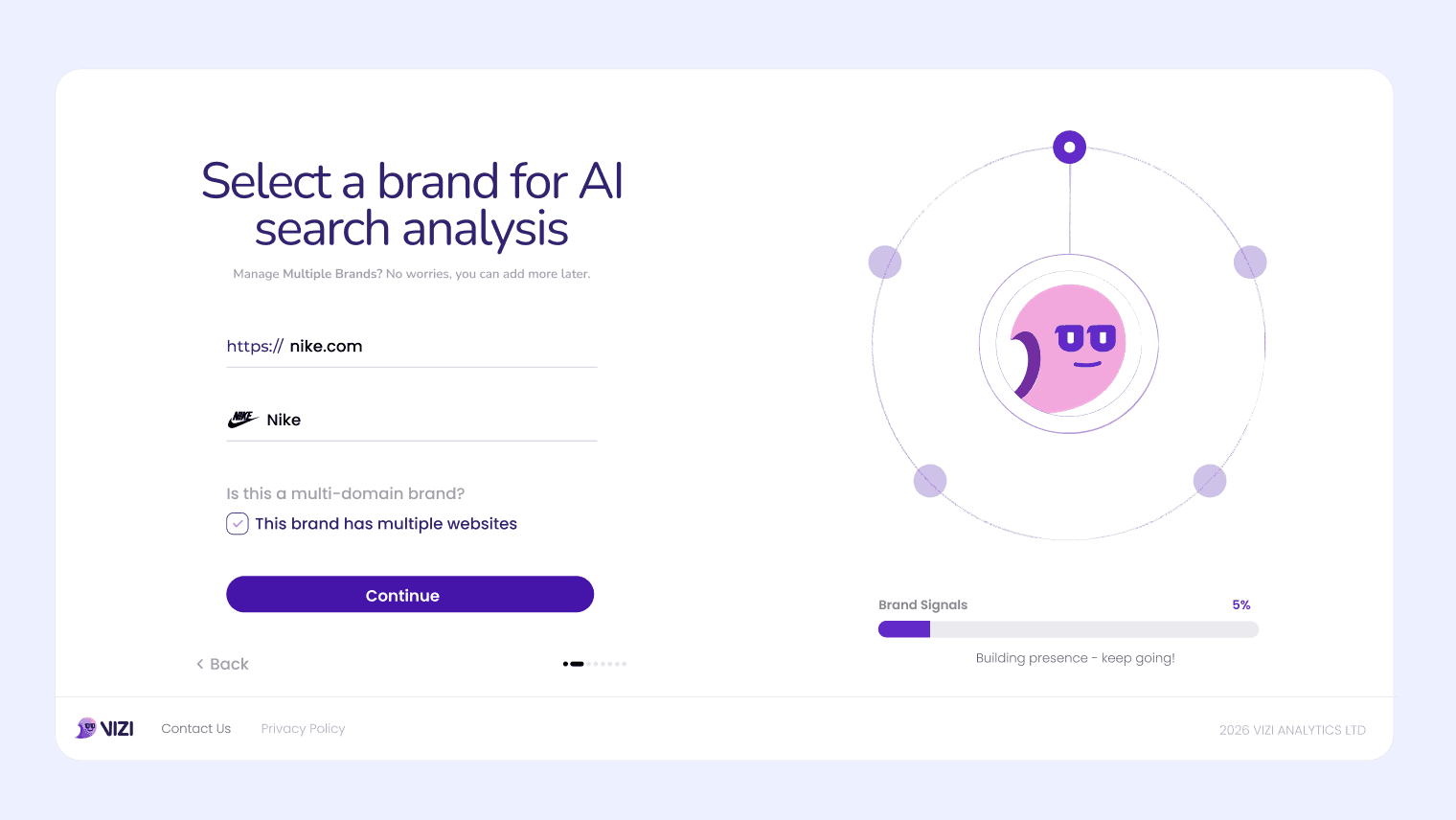
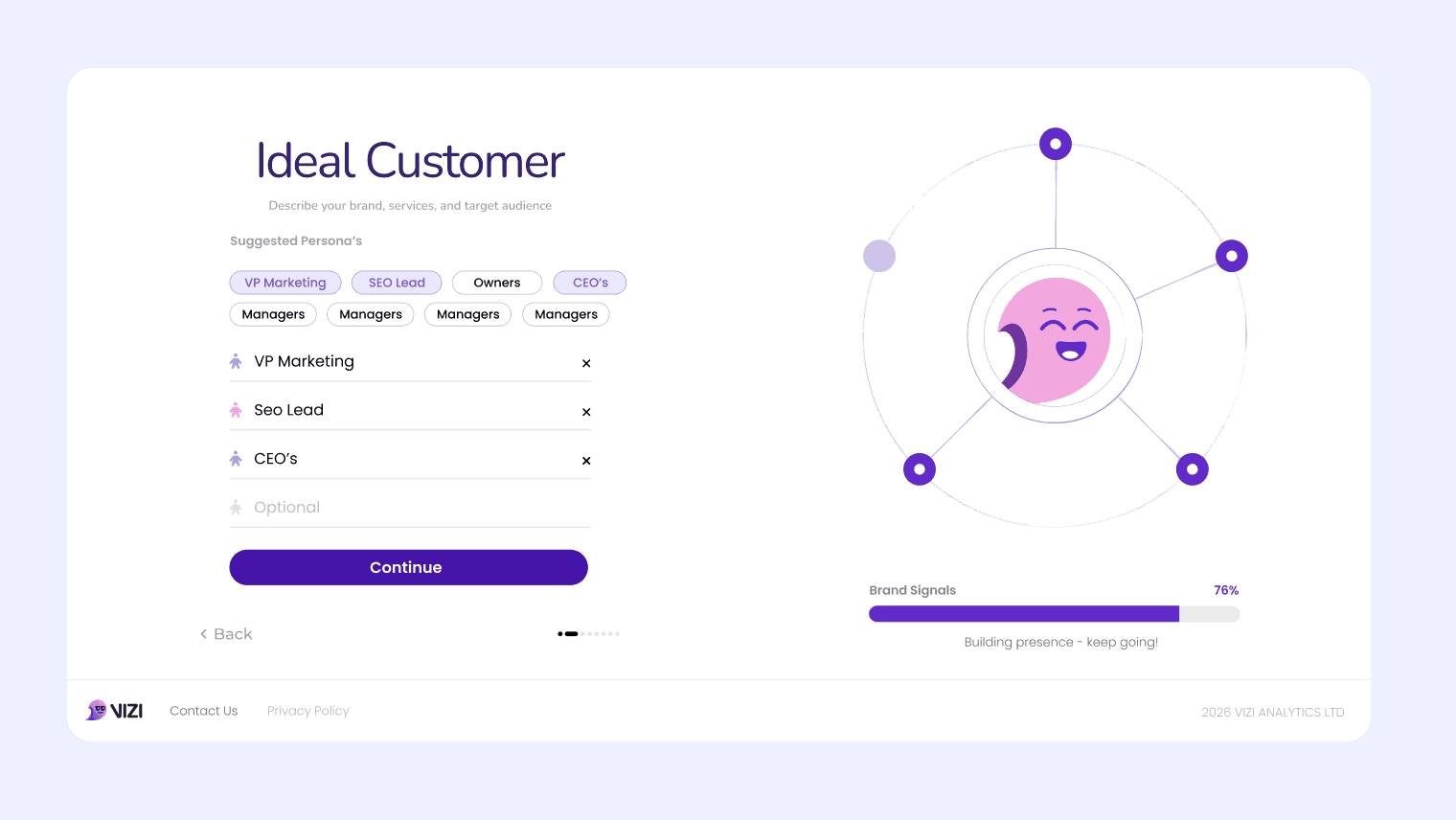
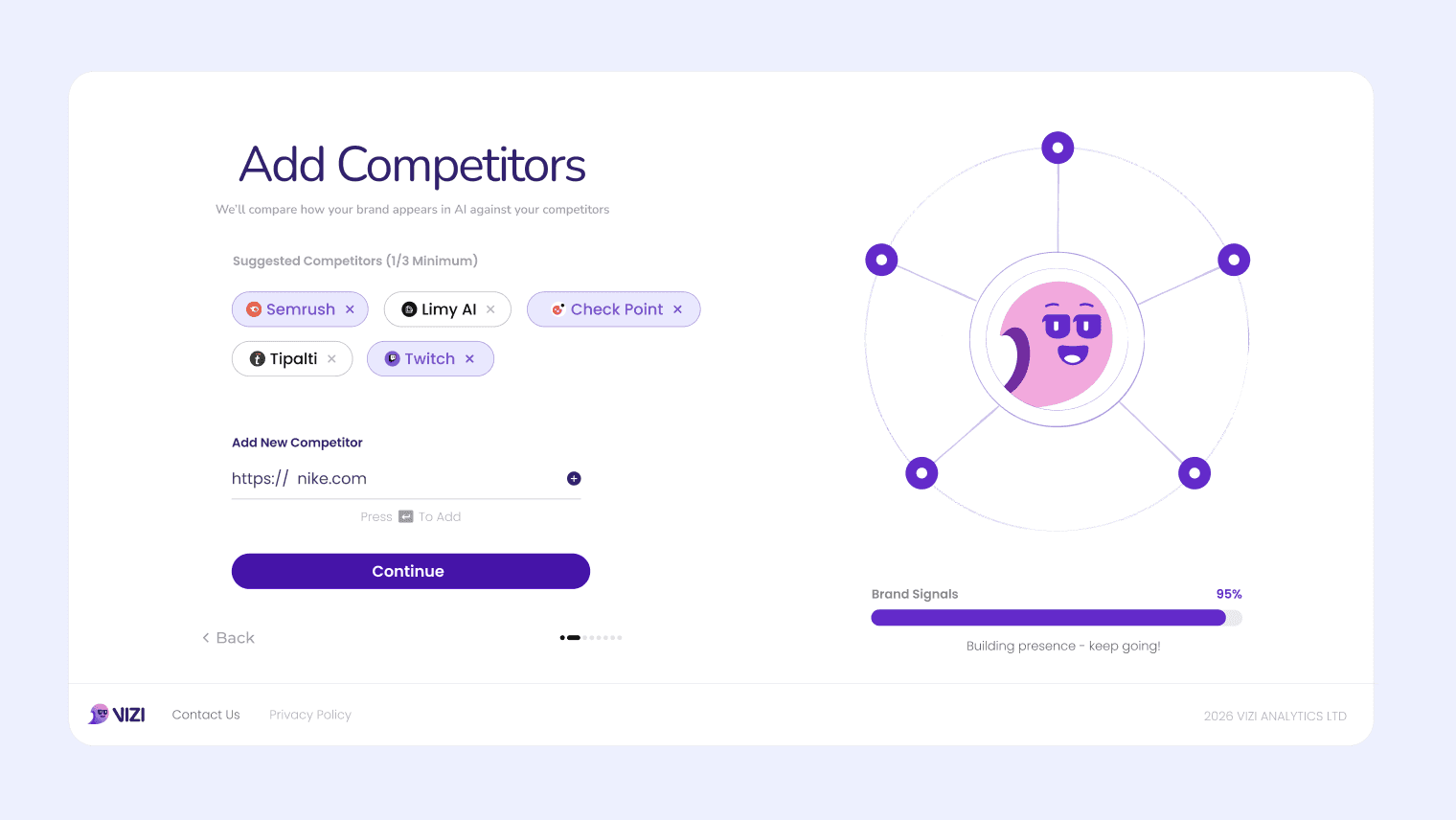
The onboarding needed to build trust without feeling like configuration work. Our research suggested a tension between the creativity marketing teams respond to and the clarity and control SEO professionals expect. We translated that into a progressive visual feedback system: as users provide more brand context, the Brand Signals indicator fills up and VIZI’s character becomes more expressive. This turns setup into visible progress — reassuring users that the system is becoming better informed, while adding a sense of personality and momentum to the experience.



BEHAVIOR > FEATURE REQUESTS
Users were taking our data somewhere else
In usage recordings, we noticed SEO professionals copying VIZI’s inputs and findings into ChatGPT and other AI tools. They weren’t leaving because they didn’t value the data. They were leaving because they wanted to interrogate it.
In usage recordings, we noticed SEO professionals copying VIZI’s inputs and findings into ChatGPT and other AI tools. They weren’t leaving because they didn’t value the data. They were leaving because they wanted to interrogate it.

Khanh Tran
SEO Lead | Villa Finder

“I usually take the data from VIZI into ChatGPT to analyze it and figure out what to do next.”
“I usually take the data
from VIZI into ChatGPT to
analyze it and figure out
what to do next.”
They wanted to interrogate the data.
VIZI data → Copy → ChatGPT → Ask questions → Reach insight
VIZI data → TALK TO YOUR DATA → Reach insight
DESIGN DIRECTION
Choosing how far AI should go
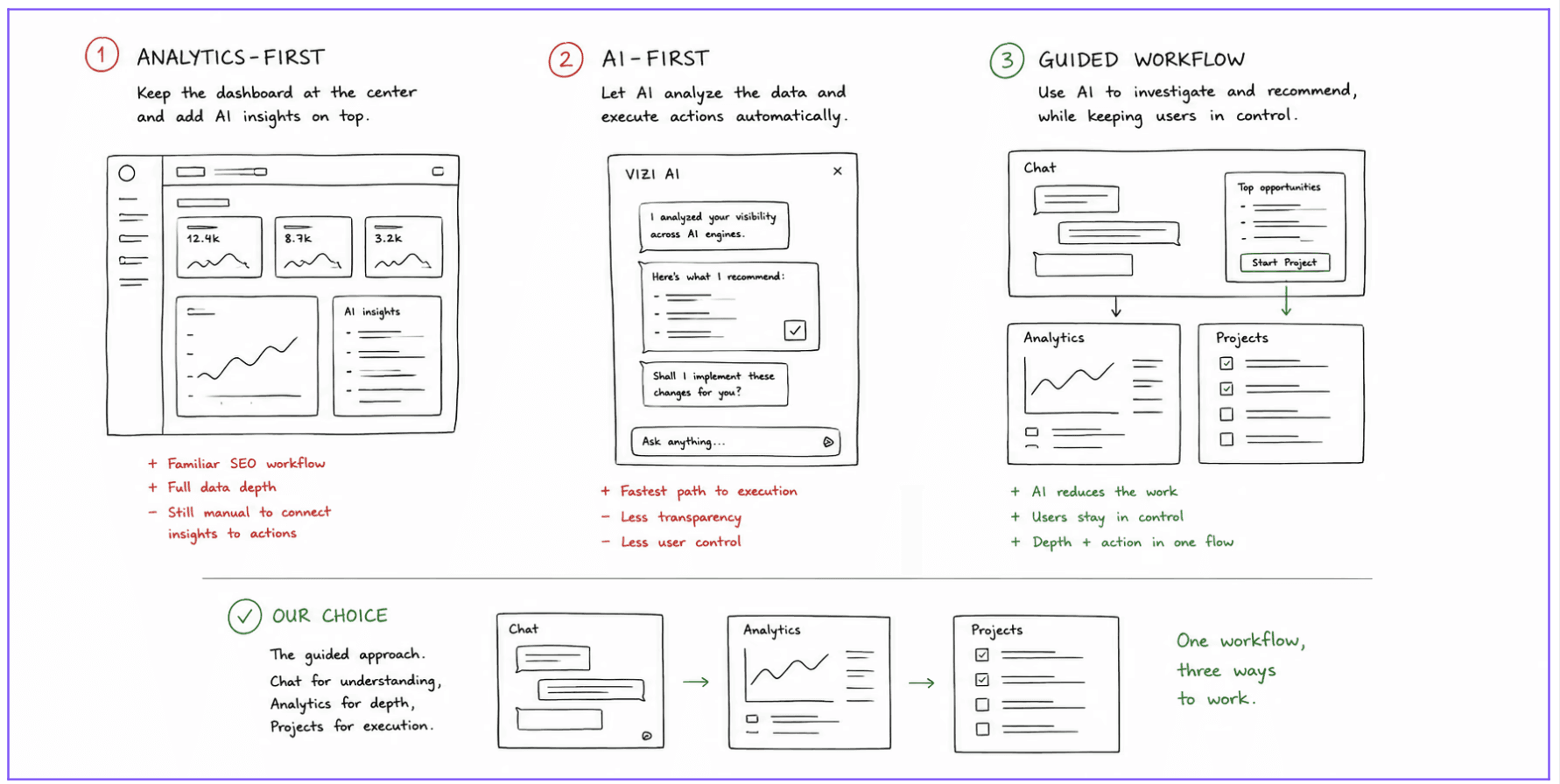
After research and flow mapping, I intentionally used AI-assisted sketching to rapidly explore multiple product directions. This helped me widen the solution space and quickly evaluate different balances between automation and user control.

Core Experience
One workflow, three ways to work
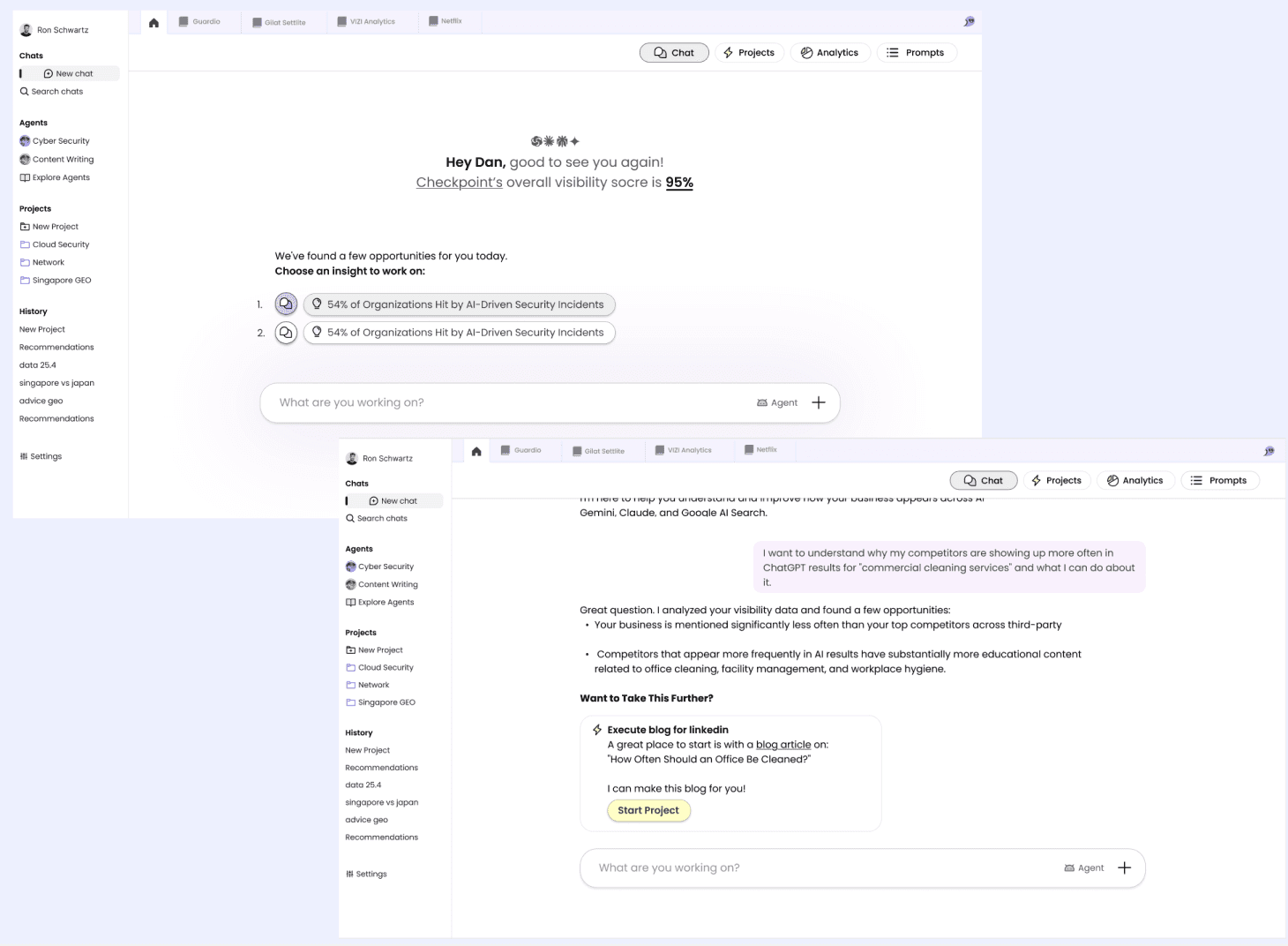
Research shaped VIZI around three complementary experiences — understand through Chat, investigate through Analytics, and act through Projects.
Start with understanding
VIZI surfaces what matters and lets users investigate their data through conversation.
FINAL DESIGN
Design one continuous path from insight to action
Design one continuous path from insight to action
The final experience connects monitoring, investigation, and execution into one workflow — while keeping the depth and control SEO professionals expect.
The final experience connects monitoring, investigation, and execution into one workflow — while keeping the depth and control SEO professionals expect.


2


2
Making insights easy to share (White Label Exporting)
Different users needed to take VIZI’s data outside the platform — agencies for client reports, comparison sites for their content, and SEO teams for internal workflows. Exporting became a way to turn insights into something others could actually use.

Reaching 200+ users within two months showed strong early interest in the problem and gave us real-world feedback to continuously refine the product around actual SEO workflows.
Our first 2 paying customers were already seeing measurable results, using VIZI insights to identify opportunities and improve their presence in AI search. Villa Finder, for example, reported clear growth in AI-driven traffic.
Reaching 200+ users in two months validated strong demand, while our first paying customers were already seeing measurable growth in AI-driven traffic.
THE RESULTS
THE RESULTS
Within two months, VIZI reached 200+ users and converted its first 2 paying customers, who were already seeing measurable impact
Within two months, VIZI reached 200+ users and converted its first 2 paying customers, who were already seeing measurable impact







Building VIZI taught me to think beyond design — to find the right problem, ship before everything is perfect, listen to users, sell, learn, and adapt quickly. As both a founder and product designer, I learned to balance user needs with technology and business, and take ownership of not just how a product works, but what we build and why.
VIZI eventually came to an end, but the experience shaped the kind of product builder I want to be — close to users, close to the business, and involved from problem to outcome.
Building VIZI taught me to think beyond design — to find the right problem, ship before everything is perfect, listen to users, sell, learn, and adapt quickly. As both a founder and product designer, I learned to balance user needs with technology and business, and take ownership of not just how a product works, but what we build and why.
VIZI eventually came to an end, but the experience shaped the kind of product builder I want to be — close to users, close to the business, and involved from problem to outcome.
Building VIZI taught me to think beyond design — to find the right problem, ship before everything is perfect, listen to users, sell, learn, and adapt quickly. As both a founder and product designer, I learned to balance user needs with technology and business, and take ownership of not just how a product works, but what we build and why.
VIZI eventually came to an end, but the experience shaped the kind of product builder I want to be — close to users, close to the business, and involved from problem to outcome.


What building VIZI taught me
What building VIZI taught me
CONCLUSION & REFLECTION
CONCLUSION & REFLECTION